
Celebrating a Doukhobor Centennial ...
The world quite likely first learned about Doukhobors on pages of old British newspapers, when Tolstoyans and the English Quaker Society of Friends drew attention to their persecution in the Russian Caucasus after their dramatic "Burning of Arms" protest in 1895. These sympathizers then helped set in motion the mass migration of more than 7500 Doukhobors to Canada in 1899, as a place of refuge. Here on this side of the Atlantic a hundred years later, local descendents recognized the heroic stand of their predecessors against militarism and war, by celebrating the centennial of those events in various ways. I too have such ancestors, and when uncertain about the use of words, I've been known to draw pictures, and chose to honour their memory, the event, and its lasting legacy, by encapsulating the Doukhobor story in a single drawing. The work needed a title ... and I remembered reciting the first lines of "Духоборец тот" (Doukhoborets Tot), a foundational Doukhobor psalm, summarizing the spiritual mission of the Doukhobors.
The drawing was reproduced in the early spring of 1995 in a small print shop at Blueberry, a small community just south of Castlegar, B.C. Functioning as a personal "unofficial" commemorative print, it was favourably received by the Doukhobor public, particularly by families unfamiliar with the story of the Doukhobors. Printed only in black and white, limited numbers such as the example below, were individually softly colourized by hand with an airbrush. The title of the print, "Духоборец тот", appears at the bottom of the circular drawing beside a double maple leaf, representing Canada, and a young lady modeling a Doukhobor costume. The Canadian symbol was admittedly copied from a mere copper penny, a design created by artist G.E. Kruger-Gray in 1937, while the traditional female costume, tailored by a local talented seamstress, was modeled by a far more valuable member of my own family. A more detailed description of the print imagery can be viewed here. (Link)
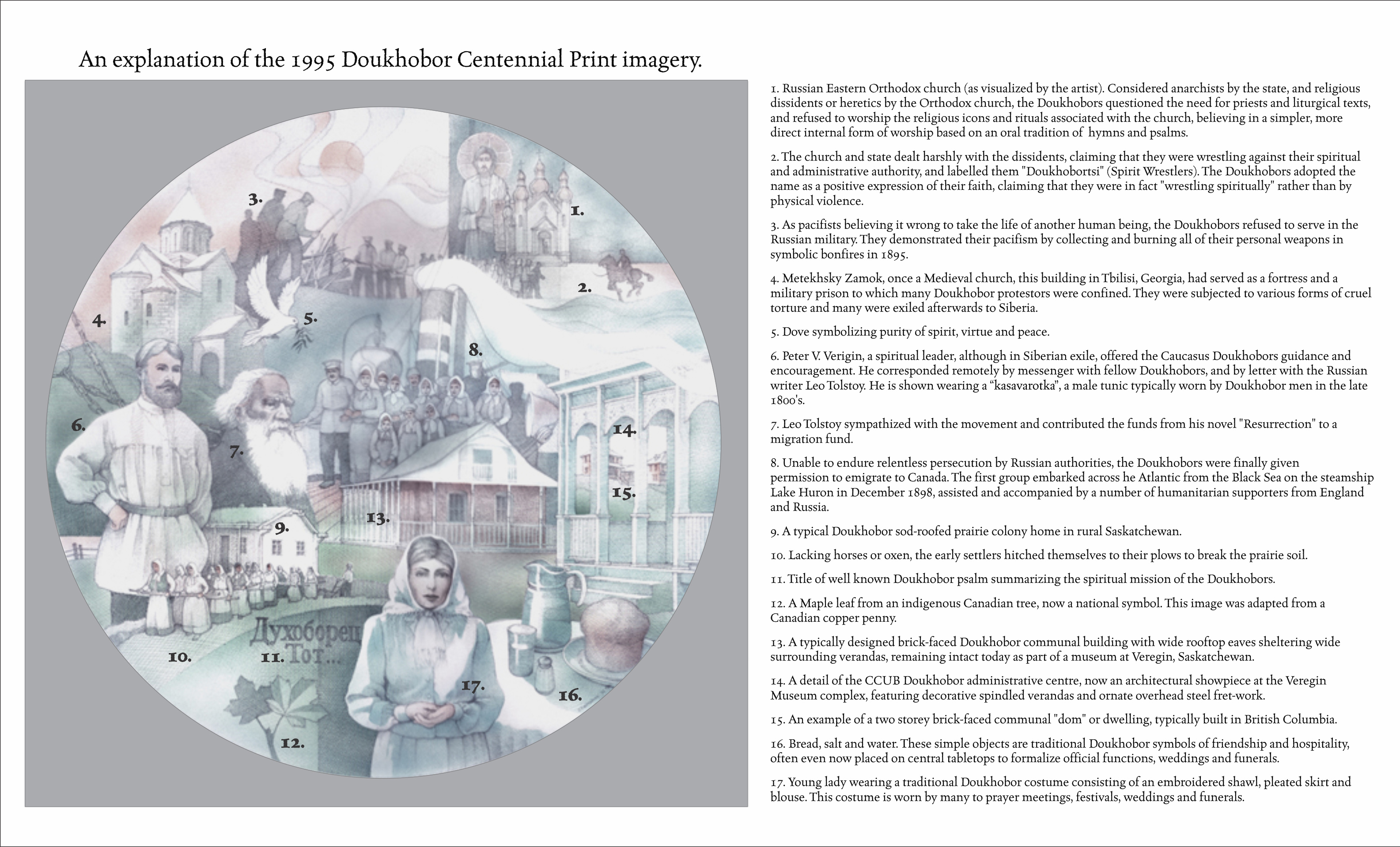
Click the print for an explanation of its contents.
"Духоборец тот" in the psalm "Sborniks"
Concentrating on the completion of the drawing at the time, I admittedly paid more attention to the print rather than the actual text or message of the psalm itself. Coincidentally, however, that same year the local USCC Kootenay Men's Group celebrated the same centennial event by publishing a booklet of hymns and psalms, titled "Vechnaya Pamyat" (In Eternal Memory), to be used as a portable guide for conducting traditional Doukhobor funerals. The booklet included the Russian psalm, and most importantly, it also featured its first known English translation. Credit was given to well-known Doukhobor writer and historian, Eli A. Popoff, for this and 22 additional psalm translations in the booklet. I was honored when asked to prepare a simple graphic of Bread, Salt and Water, traditional Doukhobor symbols, for this worthy project.
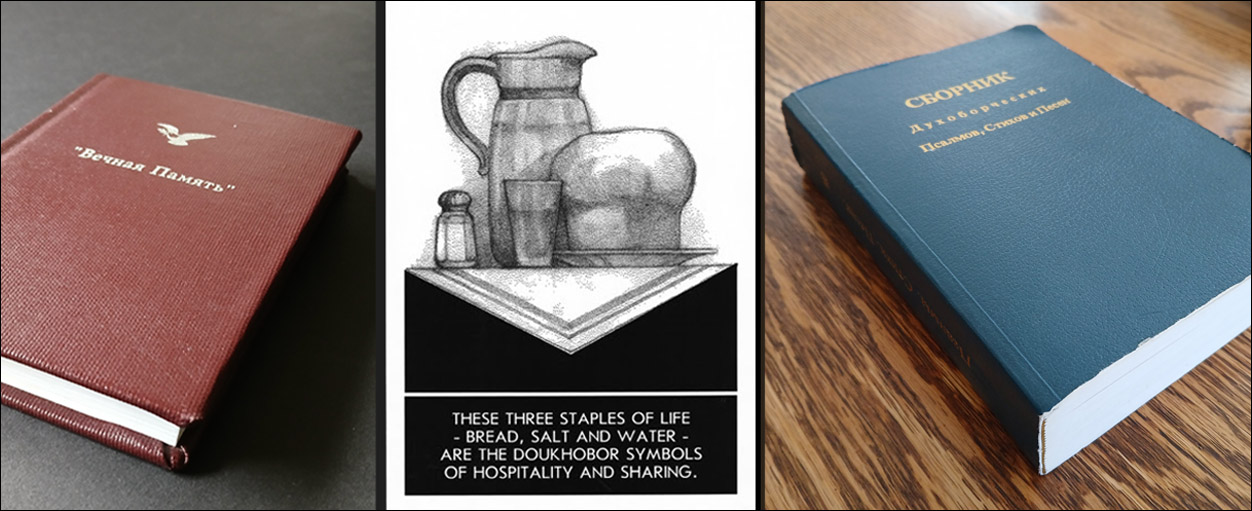
"Vechnaya Pamyat" - "Bread Salt and Water" - "Sbornik"
In reality the psalm "Духоборец тот", had already been included in a voluminous "Sbornik" or collection of hymns, psalms and folk songs published yet in 1978 by the USCC Doukhobors (Union of Spiritual Communities of Christ). Initiated by the USCC Executive Committee in the 1950s, the monumental task of compiling this historic collection of Doukhobor cultural/spiritual materials was carried on for some two decades, and the final stages of editing and publishing it all in book form was entrusted to Peter Legebokoff, a respected local historian, writer, and former ISKRA editor. He is depicted below in an exceptional portrait by professional photographer, Robert Minden, next to Mrs. Anna P. Markova, mother of then USCC leader, John J. Verigin Sr., who assisted him with this initiative.
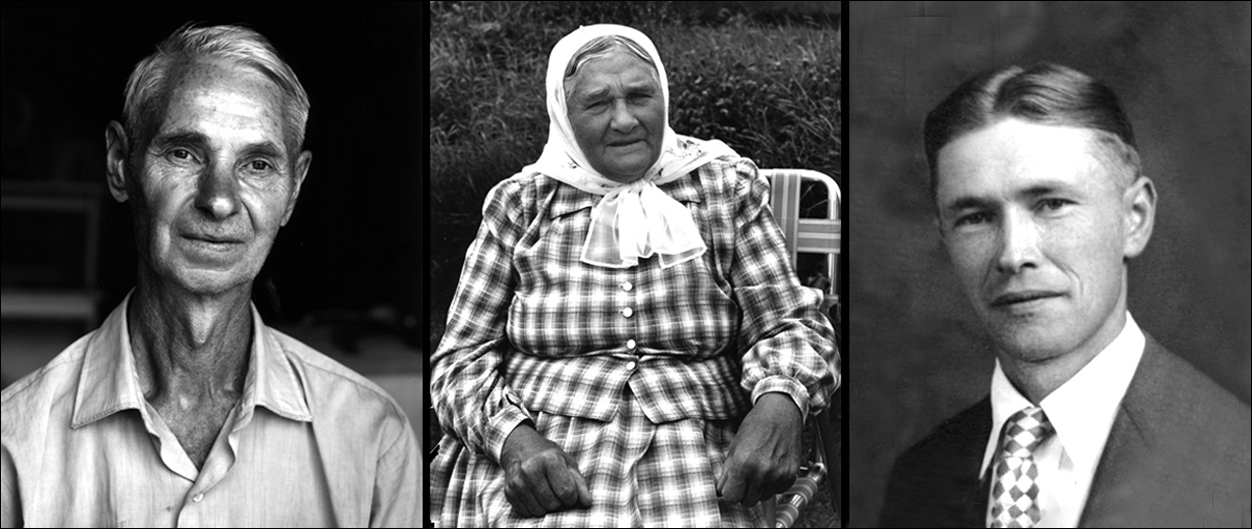
Peter P. Legebokoff - Anna P. Markova - Eli A. Popoff
The psalms in the two "Sborniks", appearing identical in every respect, are reproduced below in their entirety, along with the psalm translation in "Vechnaya Pamyat", as they were published.
Russian version of "Духоборец тот" as published in both the 1978 and 1995 Doukhobor books.
Господи благослови.
Духоборец тот, кого избрал Христос для воплощения Своего. Божество обитает на земле во плоти, из которого выражается бесконечная мудрость. Иисусу Христу нужно было иметь плоть и быть человеком, ибо устами человеческими глаголет Господь. Церковь апостольская и гора Сион есть община духоборцев. Посреди горы живет дух Божественной мудрости, сила Бога в человеке. Обитающий в них источник воды живой благовествует о вечной жизни. Их добродетель, хорошая жизнь, восторжествует над миром или земным царством, которому конец приближается. Тогда духоборцы станут известны всему человечеству и Христос один будет достойным Царем. Вокруг Него соберутся все люди. Только этой славе будет предшествовать время скорби и испытаний. Борьба будет ужасная, правда одержит победу и водворится Царствие Божие на земле.
Богу нашему слава.*
*Footnote: Иная старинная версия этого псалма имеется в книге Ф. Л. Ливанова "Раскольники и Острожники", том 2-ой, ("стран. 492. Издание 1870 г., Санкт-Петербург") В свою очeредь, Ливанов взял его из книги о духоборцах немецкого писателя Гакстгаузена, опубликованной в 1847 г.
"Духоборец тот" English translation by Eli A. Popoff in "Vechnaya Pamyat" (1995)
Originally translated on Feb. 8th, 1981, and published in 1982 in his "Historical Exposition on Doukhobor Beliefs".Lord, Give Us Thy Blessing -
A Doukhobor is one whom Christ has chosen for the continued embodiment of His Spirit. The Spirit of God dwells on earth within a physical body, through which is emanated eternal wisdom. It was necessary for Jesus Christ to have a body and be a physical being, for it is through the lips of man that God speaks. The apostolic church and the Mount of Zion are embodied in a commune of Doukhobors. Within this Mount lives the spirit of Divine Wisdom, the power of God as exemplified in man. Present within this Mount is a source of living water from which emanate glad tidings of Life Eternal. The commune's virtues, its exemplary life, shall triumph over the world — this earthly materialistic kingdom — whose end is nearing. Then, Doukhobors shall become known to all mankind, and Christ Himself shall be the only worthy King. Around Him shall gather all nations. Only this honour shall be preceded by a time of great trials and sorrow. There will be a terrible struggle, but Truth shall conquer all, and the Kingdom of God shall be established on earth.
Our God Be Praised.
Both the 1978 and the 1995 booklets are still widely used today, the English translations referenced particularly by those less fluent in the Russian language. But even among those more able to speak or read it, should they ever open a 1978 Sbornik to verify the text of the Russian psalm, they might easily overlook its short associated footnote. As it is pertinent to the present article, it is provided here in English:
Footnote in English translation:
*An older version of this psalm can be found in F. L. Livanov’s "Raskol'niki i Ostrozhniki" (Schismatics and Prisoners), Vol. 2 (p. 492), published in 1870, St. Petersburg. Livanov, in turn, took it from a book about the Doukhobors by the German writer Haxthausen, published in 1847.
The reference in the 1978 Sbornik is very specific, revealing the page number as well as the date of the volume in question, these details presumably taken directly from an actual hard copy of the Livanov book in 1978. The USCC community at that time did in fact maintain a respectable Russian and English library next to the ISKRA office in Grand Forks. The Haxthausen reference is less specific, and his book was less likely to be on hand, although we can now confirm its identity. Non-fiction books such as these did eventually become available in digital form online, easily accessible as Google Books after 2005. Anticipating their potential usefulness and insight into the origins of the Doukhobor faith, I acquired a collection of Livanov, Novitsky and Haxthausen writings, fully recognizing that their manual translation at that time would have been an overwhelming undertaking. Now in 2025, modern technologies and artificial intelligence have finally made it very much easier, and we can make use of these tools to take a closer look at the Livanov and Haxthausen writings, referenced in the footnote.
The DeepSeek Chatbot and "Doukhoborets Tot"
A web page elsewhere on this website had already examined the capability of the Chinese DeepSeek AI chatbot to translate such historic Russian writings, with many examples posted online. (Link) A casual search within these digital books, perhaps not surprisingly, revealed that virtually all of the writers had something to say about Doukhobor psalms, in three different languages. (Link) And the use of DeepSeek to compare their published versions of Doukhoborets Tot, turned out to be my first practical use of this new AI chatbot, the workflow in a roundabout way, becoming a matter of "following footnotes". The four writers in question are depicted below, sequenced left to right, in the order they were encountered throughout this inquiry.

Baron von Haxthausen - Fyodor Ivanovich Livanov - Vladimir D. Bonch-Bruyevich - Orest M. Novitsky
Origin of the psalm in the "Milky Waters"
In the latter half of the 18th century, as the Doukhobor spiritual movement coalesced in various regions of the Russian empire, individual leaders and groups were subjected to relentless persecution for their refusal to accept the established order and doctrines of the Russian Orthodox Church. Fyodor Livanov's writings described their unique circumstances and their suffering, province by province, as did Novitsky's writings in Volumes I and II. With their very survival in question by the end of that century, the Doukhobors were given reprieve by Tsar Alexander I in 1802, when he set aside a large tract of distant steppe lands in southern Russia along the Molochnaya River (Milky Waters) north of the Azov Sea for their resettlement, where they were finally free to build their own villages, practise their faith and pursue their livelihood. Here they were also soon joined by like-minded groups of Mennonites and Molokans. (Map)
In the mid-1840s a German intellectual, Baron von Haxthausen, with agricultural expertise acquired in his home country, expressed an interest in Russian peasantry and their mir commune system of rural land tenure. A Russian ambassador stationed in Germany at that time took note of his expertise, and invited him on behalf of Tsar Nicholas I to visit Russia to also study its own rural institutions, conceivably thereby to understand and manage the vast interior peasant population. He toured European Russia, the Crimea and the Caucasus over a period of six months, especially taking an interest in the Old Believers and German Mennonites who were then considered capable agriculturists. He is depicted here in what appears to be a self-portrait among a group of bearded peasant "Raskolniki" (Old Believers) accepting a loaf of bread as a gesture of their hospitality ...

His itinerary also included the Molochnaya region and the Taurida province, where the Doukhobors had by that time developed a thriving settlement centered around Savely Kapustin's village of Terpenie, a portion of which is depicted in his sketch and village plan below.

While visiting the Mennonites, he befriended Mr. Johann Cornies, an agricultural expert like himself, and together they toured the Doukhobor villages of Bogdanovka and Terpenie. Haxthausen was linguistically also fluent in French and Russian, and he may presumably have interviewed both the Doukhobors and the German Mennonites in their native languages. But he primarily learned most about the Doukhobors from Johann Cornies, and it was there and then, that he first acquired this Doukhobor psalm.
Later back in Germany in 1847, he published his findings in an ambitious book on the subject in the German language, titled in translation, "The Russian Empire, its People, Institutions and Resources". This historic work later served as a catalyst back in Russia to reinvigorate scholarly interest in its own history and its peasant sectarian movements, eventually contributing to the abolition of serfdom in the Russian Empire in 1861. Livanov and Novitsky were among many writers motivated to further pursue and document this history, in their case, from their perspectives as Russian Orthodox researchers and theological scholars. In the course of their research, it appears that it was Fyodor Livanov who first encountered and focused on the Doukhobor psalms in Baron von Haxthausen's writings. Little did he know that they would be cited in the 1978 USCC Sbornik, and sung in 2025 in slightly different form, by Doukhobors in British Columbia.
Acquiring the two psalms
Haxthausen's original acquisition of the Doukhobor psalms is briefly described in one sentence in the German and French editions of his book in a brief introductory paragraph to the psalm(s) on pages 400 and 368:
German edition page 400: There are two books in their possession, considered dangerous, one entitled: "The Key to Understanding or to the Mystery" the other a kind of textbook containing all their doctrines. However, until now, neither the government nor the friends of the Dukhobors have managed to obtain them; they are extremely secretive about them, and even Mr. Cornies, whom they regard as their benefactor, has not succeeded, despite pleas and offers of significant sums of money, ever in seeing them. Instead, Mr. Cornies received from them a psalm and several prayers, which I include here in translation.French edition page 368: It is said that the Dukhobors possess two written works. The first is entitled: The Key of Reason or of the Mystery, and the second contains their doctrine. Until this day, no one has been able to obtain them. Even Mr. Johann Cornies, whom they regard as a benefactor and for whom they all have the greatest attachment, could not succeed in getting them to show them to him, despite his earnest entreaties and the considerable offers of money with which he hoped to tempt them. They only gave him in writing one psalm and two of their prayers.

The Doukhobor psalm reference does indeed appear in the final sentence of these paragraphs, but now looking at these translations, the first sentence about a curious "secret" book, the "Key to Understanding or the Mystery", would also seem to merit at least a brief explanation.
These books, said to be possessed by the Doukhobors, were relatively unknown and not eagerly shared with the Mennonites, but a reference to one came to light in Orest Novitsky's Volume II (in 1882), as a mystical work by Karl Eckartshausen, curiously associated with the early Doukhobor leader, Siluan Kolesnikov.
"According to the testimony of the Yekaterinoslav Doukhobors, in the Kolesnikovs' house they read, among other things, "The Key to Understanding", a mystical work by Eckartshausen, from which Siluan apparently borrowed some of his mystical concepts." (Link)
The Doukhobor association with this mysterious book was not however confirmed elsewhere, and modern researchers have now suggested that Novitsky may have been mistaken or misinformed on this matter. While Eckartshausen may have written such a book, and it may have influenced their thought, another historic book with a similar title was discovered in 1875 by Russian writer and journalist, Nikolai S. Leskov, who was at the time critical of the Orthodox church. The book itself, "Key to Understanding", (Klyuch Razumieniia), was written in 1669 by a Ukranian Orthodox church leader, Ioannikii (Ioaniky) Galiatovsky (Link) of the Kyiv-Mohyla Academy, in defence of the Old Believers who rejected the Orthodox church reforms introduced by Patriarch Nikon in 1652. These Raskolniki (Old Believers - previously pictured) remained faithful to their original older church traditions, and were subsequently persecuted for their dissidence, and this book seemingly offered them defensive language and practical strategies to rationalize or justify their resistance.
Doukhobors could understandably have likewise, later adopted certain strategic texts from this book in their own defence against the accusations of the Orthodox church, while also absorbing the "mystical" aspects of Eckartshausen. And it is indeed quite possible that these were the very "secret" books sought by Johann Cornies.

At left: Karl Eckartshausen - "Key to the Mysteries of the Miraculous", (Klyuch k Tainstvam ...), 1791 (Link)
At right: Ioannikii (Ioaniky) Galiatovsky - "Key to Understanding", (Klyuch Razumieniia), 1659
These notions are certainly intriguing and there is more to this story, but this subject is also well beyond the scope of this web page, and we can now return to Haxthausen, and the psalm he received from the Mennonites ...
Haxthausen's German Edition
The Sbornik footnote characterization of August Freiherr von Haxthausen as merely a "German writer who wrote a book about Doukhobors " was of course an understatement. We now know that his German, "Studien uber die inneren Zustande, das Volksleben, und insbesonders die landlichen Einrichtungen Russlands", (The Russian Empire, its People, Institutions and Resources) was published in three volumes, Volumes I and II published in Hannover (1847), and Volume III, in Berlin (1852). There were also three French volumes (1848-1853), an abridged English edition in 1856 and another more recent translation in 1972.
Searching through Haxthausen's German Volume I (1847) and translating suspected relevant pages, two psalms were finally found on page 401 and 402, the Doukhobor psalm in question, in the second column.

A typographical analysis
At first sight, these pages were admittedly somewhat visually overwhelming, as Doukhobor historical documents are rarely seen in Old German printed form. Yet a closer look revealed a familiar typeface, similar to a family of modern computer typefaces and fonts. Viewing a sampled comparison, it became apparent that Haxthausen's German edition had been styled in what is generally known as a "Blackletter" typeface, a bold calligraphic hand-lettered style that had been in common use in Germany in the 1800s, ever since the first publication of the Gutenberg bible in the 1450s. There were six variants within this group, this particular one identified as "Fraktur", so called because the original hand letter-forms were drawn in multiple distinct angled pen strokes.
The history of Blackletter in German liturgical writing has been thoroughly researched by modern typographers, and as might be expected, it was found to be favoured by Lutheran Protestants rather than Catholics over the centuries, the latter preferring a Roman typeface called, Antiqua, similar to modern Times Roman. Baron Haxthausen, a known Roman Catholic, addressed this dichotomy in 1847 by publishing editions of his book in two languages, and the second, his French edition, was printed in a Roman typeface.
This diversion into typography is of course only secondary to the content of the text itself, but there may be a practical purpose to it. Should such Old German text need to be reformatted for other purposes, it could be imported into modern software and restyled with the Fraktur typeface, as demonstrated in the following examples. At left, Haxthausen's "column two" has been reconfigured into a single column for increased legibility. At right is the modern version of Doukhoborets Tot, enshrined in blackletter "for the ages", so to speak, as a manifesto or formal declaration of the Doukhobor spiritual mission. For adventuresome readers interested in attempting such a workflow, a free typeface, "Schwabacher", one of the six in the blackletter group, can be found online.

As for Haxthausen's psalms on pages 401-402, this antique foreign typeface does indeed seem to elevate their historical significance as "words of wisdom", while making them seemingly more worthy of consideration by readers and curious researchers.
The overall visual layout of the pages is also quite unique, the two "psalms" placed side-by-side in a two column parallel format, unlike all other pages in the same volume that appeared in a single column serial form. This anomaly appears to have been deliberate, perhaps as a means to emphasize the close relationship or interdependence of the two columns. Yet at the same time, the Baron's own French edition (also 1847) appears to have abandoned the German two-column format for these same two pages.
The Haxthausen left column of page 401 in translation, had been simply titled a "Psalm", rather than a number, while the right column had its own rather unique title in bold blackletter type, not specifically named or numbered as a "psalm".

Looking to DeepSeek for a nuanced translation, we find that this title is a German transliteration of a Russian phrase, obviously related to the Doukhobors.
Unslegung = Изложение (Izlozheniye)
Belchrung = Веручения (Verucheniya) - an archaic/folk form for "of the faith"
Duchaborgen = Духоборцев (Dukhobortsev)
So the German title in the Russian language is most likely: "Изложение веручения духоборцев" (Izlozheniye verucheniya dukhobortsev.) And in English: an "Exposition of the Faith of the Doukhobors", or more eloquently, "A Doukhobor Statement of Faith."
As to whether "A Statement of Faith" could be considered a psalm? Likely yes. The notion of a psalm in Doukhobor discourse may arguably be a matter of interpretation, as many psalms were often randomly acquired selections of archaic biblical excerpts, writings or spoken words of their leaders, transcripts of answers to questions by church or government officials, and so forth. And in that sense, this text could be considered a psalm, although it has not been explicitly stated so here. Why this 2nd Column psalm was given an alternate name is unknown, although the relevance of its name is not as much an issue in this inquiry as is the actual content of the text.
In overview, what we have here in this German edition, appears to be one confirmed early Doukhobor psalm in column one, alongside what is now thought to be a later version of this same psalm in column two, both being early versions of the modern Russian psalm, Doukhoborets Tot.
While this relationship between the psalms appears to be maintained in Livanov and Novitsky, their naming and numbering has not, challenging this inquiry every step of the way. Haxthausen referred to the one psalm as a "Psalm", the other as "A Doukhobor Statement of Faith", Livanov later numbered the two psalms as, Psalms I and II, Novitsky identified them as Psalm 4 (I) and Psalm 5 (II), (Link) and Bonch-Bruyevich would later identify only one psalm, Psalm 4 (I) in his "Zhivotnaya Kniga" or "Living Book", as Psalm number 71.
Authenticity and meaning
Although the German Haxthausen psalms are indeed visually and historically interesting, it is worth noting that they were not received by Baron Haxthausen directly from the Doukhobors themselves, and their text in that respect, cannot be considered first-hand primary source historical material. The primary sources, the original Doukhobor psalms, were said to have been given to Mennonite Johann Cornies "in writing", likely as hand-written notes in the Russian language. They were then filtered through German Mennonite hands, and given to Haxthausen, either in Russian form, or as German translations, although he seemingly claims to have done his own translations from Russian to German for his first book. Moreover in time, these early versions of the psalms would be further complicated by additional translations to French, English, and ultimately back to Russian, when they were ultimately addressed by Livanov in 1870 and Novitsky in 1882.
Despite their "second-hand" nature, the historical significance of these early psalms in their German language, should not be minimized. They are likely the first professionally published versions of Doukhoborets Tot to ever appear in print, in any language for that matter, in its formative years.
Fyodor Livanov's Russian Volume
Pursuing the USCC 1978 Sbornik reference to Livanov and his writing was assumed to be a simple enough task, as it included a specific volume and page number, Vol. 2 (p. 492), and I had already translated eight chapters of Livanov's Volume II, "Raskol'niki i Ostrozhniki" (Schismatics and Prisoners), now online. But this psalm was surprisingly not among them. It was found in Chapter XXIV - Part III, of a different chapter dealing with the Simbirsk Molokans and Doukhobors, although looking at it closely, the substance of the psalm was not in itself geographically specific. (Map) Extracted from the volume, this full chapter (XXIV in Russian) has now been posted here in its entirety. (Link) Part III by itself can be viewed here in Russian form, (Link) and its English translation here. (Link) The relevant two pages themselves are illustrated in the graphic below, the Sbornik psalm in question as No. II, on page 492, along with another psalm titled Roman numeral No. I beginning on page 491. (Click the pages to view an enlargement)
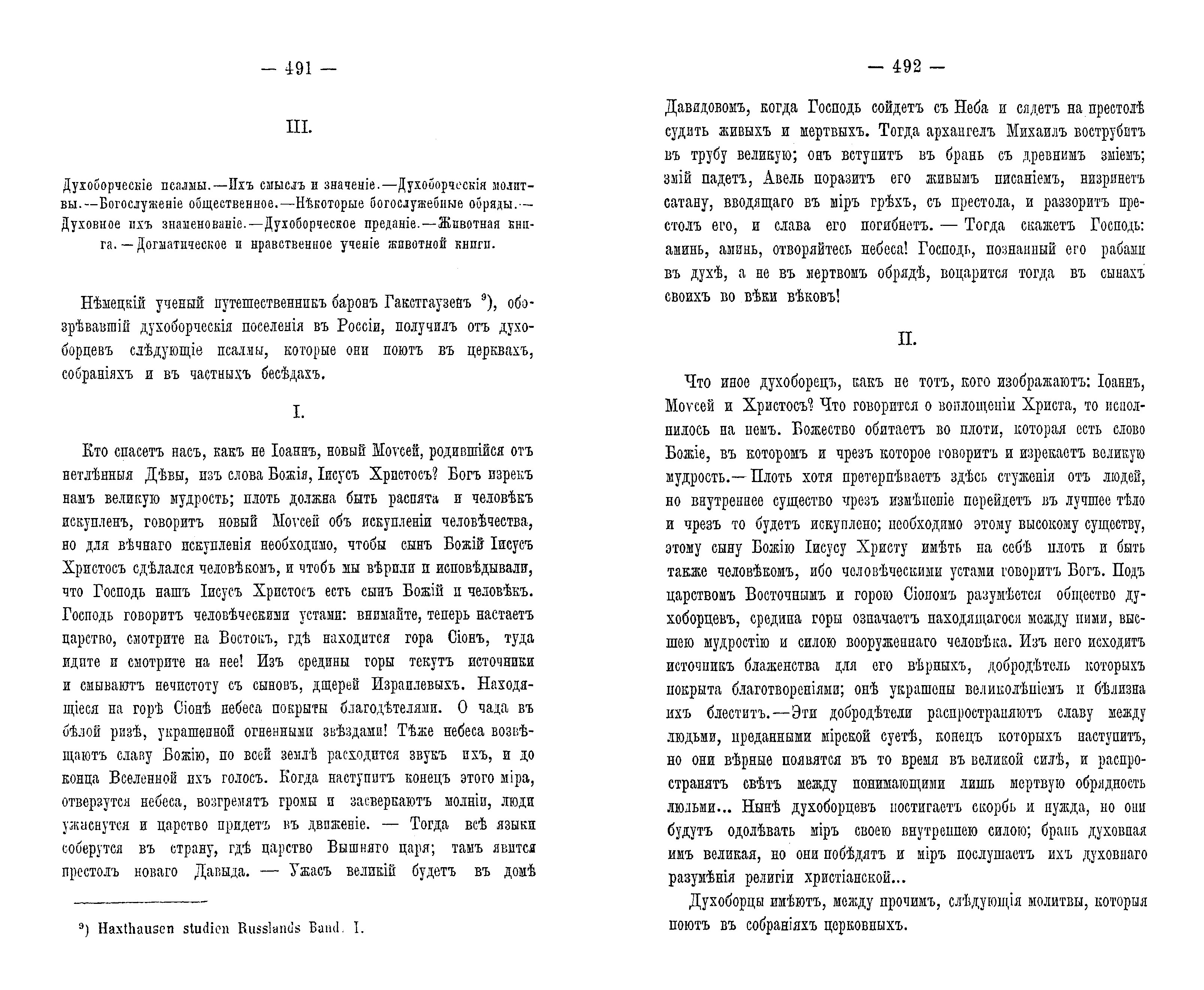
Looking back at 1978, and the publication of the Sbornik, the discovery of this early psalm in Livanov's book by the compiler/editor, presumably P.P. Legebokoff, would seem to have been a remarkable accomplishment, entailing a thorough reading of all the relevant chapters in a hard copy of an expansive volume, without the benefit of modern electronic search. The general volume table of contents would have been helpful, but Livanov had astutely also created useful lower-level "part previews" summarizing their content, immediately following their respective Part numbers. In this Part III example, these two psalms are characterized as "Духоборческіе псалмы.—Ихъ смыслъ и значеніе", (Doukhobor Psalms.—Their Meaning and Significance).
Also in this example, a subsequent introductory paragraph offers readers insight into the German source of the psalms that are to follow. The Haxthausen paragraph itself was depicted earlier on this page, in a discussion about his German Volume II. (Link) The following text is a Livanov translation ... "The German scholar and traveler Baron Haxthausen, who visited Doukhobor settlements in Russia, received the following "psalms" (plural) from the Doukhobors, which they sing in churches, gatherings, and private meetings. (Footnote - German edition Studien Russlands Vol. I)".
And this may indeed have been where Peter Legebokoff himself had found the reference to Haxthausen, which he then cited in the Sbornik. Referring back to this 1978 footnote once again, what appears to be curiously missing in the text is an attribution of the psalm to an earlier particular Doukhobor source, while the editor at the same time also either overlooked or disregarded the significance of Psalm I, in spite of its close sequential association with Psalm II.
An English translation of the pages offers us a means to compare and understand the difference between them. (Link) Both psalms share a good part of their liturgical content and style, although Psalm I is "enriched" with biblical allegories, metaphors and phrases, such as ".. the Archangel Michael sounding heavenly trumpets and doing battle with serpents". Psalm II is simplified, or dare we say, secularized somewhat, without an over abundance of biblical phraseology. And therein may be a possible explanation for his choice between the two psalms.
Doukhobor oral histories have generally attributed the original composition of "Духоборец Тот" - ("Doukhoborets tot") to one of their early leaders, Saveliy Kapustin, who served in that role from about 1790, until his death in 1820. Further evidence, a Novitsky footnote, in a later web page segment, will confirm that both of these psalms were known and in use in Kapustin's time. There is also a lesser known notion that Kapustin's psalm (Psalm II) may have actually been adapted from an earlier psalm, possibly Psalm I, by his immediate predecessor, Illarion Pobirokhin, both leaders associated with Tambov province. And surprisingly even beyond that, an excerpt in Novitsky's writing (1882) also revealed a possibility that the older "more biblical" psalm (Psalm I) may have been authored by Siluan Kolesnikov, an even earlier Doukhobor leader. This leader was known for appeasing obtrusive Orthodox church authorities and investigators by offering them explanations of Doukhobor faith strategically peppered with extensive biblical language, such as "Archangels doing battle with serpents", to distract them from what may have been otherwise perceived as church heresy. (Link)
Despite the uncertainty regarding their authorship, there is nonetheless undeniable similarity between Psalm I and Psalm II to suggest, more likely than not, that the former was the parent version of the latter, and the latter was most similar to the modern version of Doukhoborets Tot. Judging by well-known trends, even in our recent 20th century, the ongoing circulation of such duplicative/alternate versions of psalms, hymns, etc. was not a rarity.
A look at a "Living Book" ...
No search for old psalms would have been complete without also consulting the Bonch-Bruyevich 1909 printed version of "Животная Книга Духоборцев", (Zhivotnaya Kniga - Living Book).
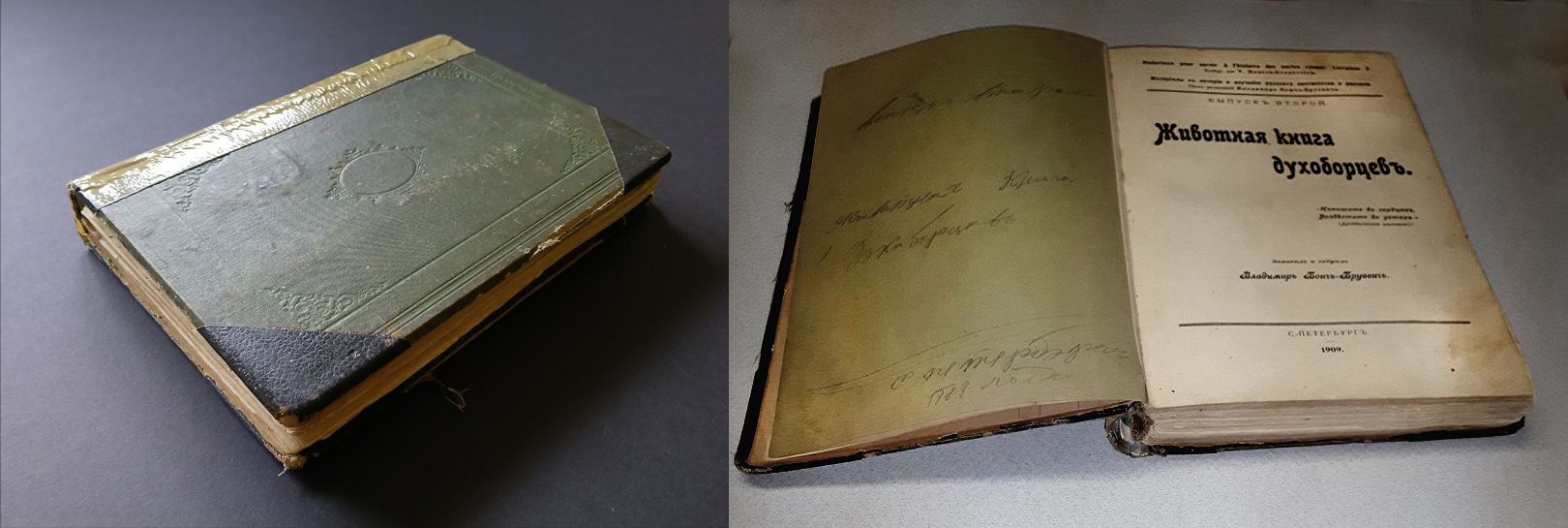
I inherited my own well-worn copy of the original 1909 "Living Book" from my paternal grandfather, although I now use a searchable digital copy of the same book if need be, to drill down to find passages of interest, while comparing the result to the hard copy.
But interestingly, this was not in reality the first "Living Book" in print. It also appeared in the same aforementioned chapter XXIV, of Livanov's expansive 1870 Volume 2 - "Raskol'niki i Ostrozhniki" (Schismatics and Prisoners). (Link) Livanov summarized his understanding of the early Doukhobor "Living Book" briefly in these words:
The Doukhobor sect places great importance on its tradition, based on the words of Psalm 43:1: "Open to us the gates of righteousness." This tradition is called the "Living Book"— a book alive in the memory and hearts of the Doukhobors, in contrast to the Bible, which, they say, is contained in dead letters that must be taught to understand. The "Living Book" consists of Doukhobor psalms, which are compiled from fragments of David’s psalms, sayings from the Old and New Testaments, and prayers and chants of the Orthodox Church. The Doukhobors have countless psalms; no single Doukhobor can know them all. Thus, the "Living Book" exists in its entirety not in each Doukhobor individually but in the whole community, distributed among their hearts and memories, so that by combining all their memories and hearts, the complete "Living Book" emerges. The book is passed down orally from generation to generation.
The concept of Livanov's "Living Book", the term itself, and the text within it, would re-emerge in "dead letter" form over a half-century later in the historic 1909 Bonch-Bruyevich printed book of psalms.
Vladimir Bonch-Bruyevich
Bonch-Bruyevich was an important historical figure, remembered by Doukhobors for his journey with the last group of the immigrants to Canada in 1899, when he lived among them for several months, interviewing the villagers, and documenting their ethnic life, and most notably their oral psalms. (Link) Once in Canada, the Doukhobors were somewhat more forthcoming, sharing their beliefs, feeling less threatened perhaps, as they were given freedom to practice their own religion. They also seemingly fully trusted Vladimir Bonch-Bruyevich and his friend and physician, Vera Velichkina, who sympathized with them and assisted them as best they could while on the remote Canadian prairies. After his return to Russia, Bonch-Bruyevich finally published his prairie findings in 1909 as an expansive compilation of the orally transmitted psalms, along with a few sayings and hymns, called the "Животная Книга духоборцев" or "Living Book".
But despite an exhaustive search in this book of hundreds of hymns and psalms, "Духоборец тот", as we know it today, did not appear to be among them. In the process of compiling the 1978 Sbornik, the various USCC Committees, elders, and final editors, had similarly confronted the reality that Bonch-Bruyevich's 1909 book, as remarkably extensive as it was, had nonetheless not been exhaustive.
What was found however was a translated version of the original German "Psalm", the left column previously mentioned. It now seems to have found a place in Bruyevich's "Living Book" on page 94 as Psalm 71.
The Orest Novitsky footnotes
A Bonch-Bruyevich footnote now pointed to Orest Novitsky, rather than Livanov, and referenced Haxthausen's 1847 "German" edition more specifically by name. The footnote was translated and appears below:
"This psalm was published by O. Novitsky in his work "The Doukhobors, Their History and Teachings" (Second edition, Kiev, 1882, p. 269). Novitsky borrowed this psalm from Haxthausen's work: Haxthausen. "Studien über die inn. Zustände Russlands". 1847. During the retranslation from German to Russian, the colorfulness of the Doukhobor language was lost, but the meaning was faithfully conveyed".
The two psalms in Novitsky's Russian 2nd edition of 1882 were labeled numerically, Psalm 4 and Psalm 5, (Link) although the latter alone had a subtitle, "Истолкованіе предыдущаго". Its English translation, "Interpretation of the preceding" is surprising indeed, confirming that the latter psalm was a version of the former psalm. Novitsky as a highly respected theological scholar, had seemingly more than others, understood and confirmed the nature of this relationship, abandoning the Haxthausen characterization of Psalm 5 as a "Statement of Faith" and retaining it as a psalm.
Another subsequent Novitsky footnote on page 271, is also noteworthy. Referencing these same psalms, it implied that "Psalms 4 and 5 were most likely composed by Kapustin, who particularly loved to speak about the incarnation of the Divine in man and in his teachings sought to primarily appeal to the imagination of his listeners."
This footnote appears to be the only reference to Kapustin as the author of these psalms in all the writings examined on this web page. But it nonetheless does confirm this same notion expressed in general historical Doukhobor oral history.
Closure unfulfilled ...
A convoluted history it may be, confounded by different writers, essentially addressing the same subject, with only different titles, names or numbers that undeniably distracted from a focus on that subject.
But perhaps the most perplexing discovery in this inquiry was the revelation that this foundational psalm was omitted or overlooked in the Bonch-Bruyevich Zhivotnaya Kniga, particularly as the very existence of his footnote had revealed an awareness of both psalms, side-by-side in the German volume, and one after another, in the Novitsky volume. To be fair however, it may be that this earlier version was still in "oral" circulation in 1900, and it was the only one that he encountered in his far from exhaustive (albeit remarkable) research effort among the Doukhobors.
There are two important and well informed modern critiques or reviews of the Bonch-Bruyevich Zhivotnaya Kniga Doukobortsev, and its 1978 English translation, one by Selkirk College professor, ethnographer, Mark Mealing- PhD, (Source) (Printable) and the other by recognized local Doukhobor historian and former editor of ISKRA, Dmitri (Jim) Popoff. As a continuous contributor to this printed "Voice of the Doukhobors", he regularly penned monthly articles titled, Adventures in Russian, With Jimitri's Dictionary of Doukhoborese, offering fascinating examples of spoken words in common usage, but distinct from the formal Russian language. He tackled the term "Zhivotnaya Kniga" or "Living Book" in a three part series (25, 26, 27) of ISKRA, that likely remains the best (if not only) informed analysis of the Bonch-Bruyevich book from a Doukhobor perspective. (Link)
An interesting footnote from the series refers to Peter V. Verigin's concerns about the Bruyevich "Living Book".
A particularly comprehensive effort was made by Peter V. Verigin, just prior to his death in 1924, in which he extensively annotated an actual copy of the 1909 edition of the Bonch-Bruevich book, indicating psalms that were authentically Doukhobor, those that weren't and should be omitted from the Doukhobor repertoire, and those that required some revision. This annotated copy was then passed on to a group of elders who were instructed to implement the leader's suggestions. One of those elders was Nikolay M. Plotnikoff, who would later be the last President of the CCUB. In the 1950s, he still had this annotated book in his possession and showed it to the late Eli A. Popoff. Unfortunately, its present whereabouts is unknown.
Related to the above footnote, but not included in Mr. Popoff's ISKRA articles, is a "key to the final understanding" of Doukhoborets Tot. Despite the clearly visible evolutionary thread between the versions of the psalm in various historical scholarly writings, there is still a wide discrepancy in the wording between the most recent version of this early psalm (presumably Novitsky's 1882 re-translation), and the wording of today's version of the psalm, as it appears in the 1978 and 1995 Sborniks at the start of this web-page.
The explanation is possibly known by some, but only recently re-affirmed here by Mr. Popoff ...
"The text of that earlier psalm was substantially re-written by the Doukhobor leader, Peter Vasilyevich Verigin, at some time after his arrival in Canada in 1902, but most certainly, prior to 1910 or so. Whether or not he was aware of the much earlier version in Bonch-Bruyevich's 1909 book is not clear, but his updated (today's) version is clearly a refinement ("modernization") of the essential meaning in the "right-hand" version.
Peter V. Verigin was clearly following in the footsteps of the previous Doukhobor leaders who took it upon themselves, not only to "modernize" existing materials from the Doukhobor "Living Book", but to compose completely new psalms, hymns, slogans, etc. In addition to adding significant new material of his own composition, Peter V. Verigin "updated" existing materials, such as this psalm. He was also the first Doukhobor leader known to have encouraged other Doukhobors from within the community to compose psalms and hymns of their own. These were then reviewed by a committee of elders and incorporated into the "official" repertoire. As a result of this initiative by Peter V. Verigin, and continued encouragement of it by his successor, Peter P. Verigin, the 1920s and 1930s witnessed very prolific creative output within the Canadian Doukhobor community, which continues, to some extent, to this very day. This is evidenced in the 1978 Sbornik, which contains scores of these "new" creations, all of which still form part of today's Doukhobor Living Book repertoire."
Interestingly, in a related side-note about psalms and psalmists, I was reminded by Vera Kanigan, a former member of the prominent USCC Kootenay Choir, that the Doukhoborets Tot psalm had not actually been sung prior to the mid-1970s by local psalmists, set aside but not forgotten. The choir had been attending varied smaller local communities at that time, making an effort to preserve or resurrect traditional song, when a single conscientious elderly lady at such a meeting quietly re-introduced the psalm by singing it, and Doukhoborets Tot has since then remained a favourite in the Sunday Moleniye prayer repertoire to this day.
A small group of West Kootenay psalmists now meets regularly to discuss and sing historic Doukhobor psalms in Brilliant B.C., as do similar groups in Grand Forks, Krestova and a very few other locations in Western Canada, while many younger contemporary Doukhobors have less patience with archaic phraseology and the more obscure metaphorical and prophetic references in our traditional psalms. We elders can sympathize with their sentiments to some extent, but there is a growing awareness of their startling relevance to the current Doukhobor and world reality, and we are all surely grateful to those, like the psalmists, who continue to maintain our common "Living Book" - with an aspirational benefit for the rest of us.
That hope seems to be slowly bearing fruit, as some members of the younger generation are now also participating, and even starting their own groups. One such group composed a new tune to another fundamental psalm, "Calm me Lord" (that never had a tune before), which has since become a mainstay for all Moleniye meetings, and other traditional gatherings. But young or old, with constant advancements in modern technologies, an opportunity even now exists for all, to bring iPads and laptops to their singing sessions, to get instant access to online recordings and translations.
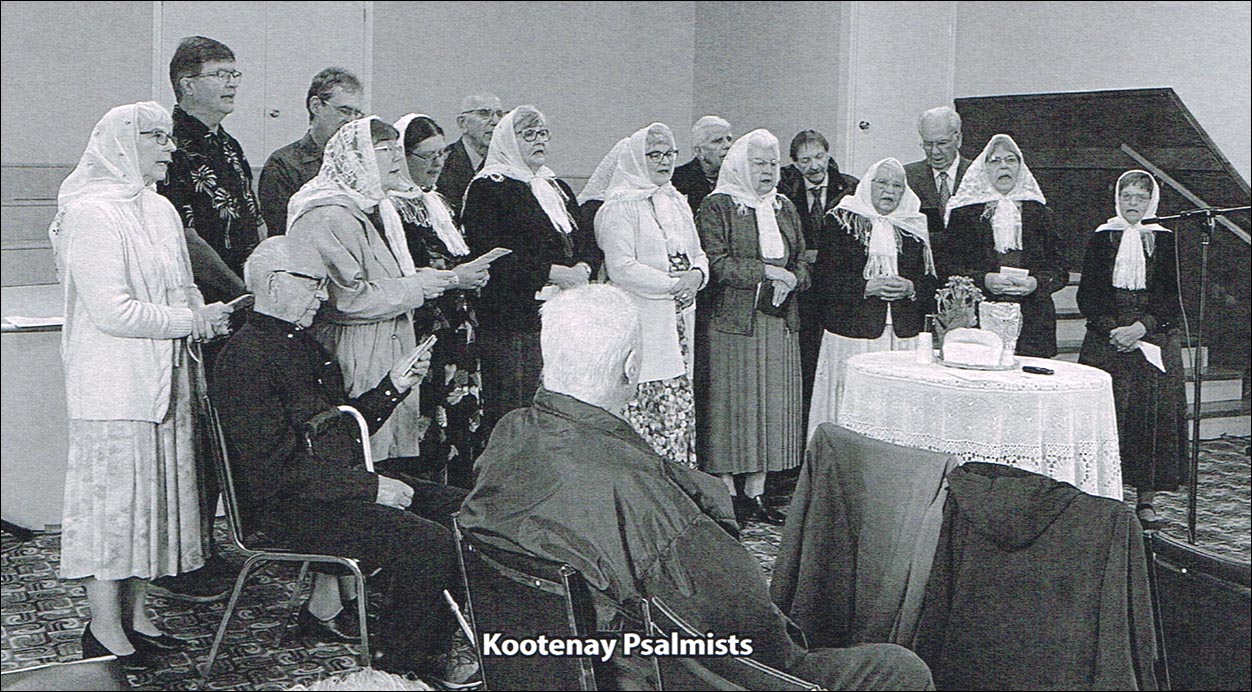
At a Thanksgiving Krestova prayer service Oct. 2025 - ISKRA 2215 photo
It remains to be seen whether and how artificial intelligence at large will help modern Doukhobors better understand their unique ancestral history, religious faith and identity, while also helping them fulfill the spiritual mission bestowed upon them by their forebears and this foundational Doukhobor psalm.
As for general unfettered trust in AI-generated content ... the DeepSeek chatbot continuously reminds users at the conclusion of every exchange, that its responses are "AI-generated and for reference purposes only".
With that in mind, and in conclusion ... here's an example of a DeepSeek re-interpretation of the existing modern version of Doukhoborets Tot ... for further contemplation and reference only. Although yet who knows, it may also in time find a place in some future Sbornik.
Lord, Give Us Thy Blessing
A Doukhobor is someone chosen to carry forward the spirit of Christ—God’s presence alive in human form. Just as Jesus needed a physical body to share divine wisdom, so too does God’s truth continue to speak through people today. The Doukhobor community represents a living spiritual fellowship, a place where divine wisdom and God’s power are visibly at work. Within this community flows a source of enduring truth, offering hope for a life of deeper meaning beyond materialism. The Doukhobors’ way of life—guided by kindness, unity, and integrity—will ultimately outlast the shallow values of the material world, which is already fading. A time will come when their example becomes known worldwide, and the true measure of leadership will be Christ-like love, not power or wealth. All people will eventually unite around this higher purpose. But first, there will be great challenges—struggles and suffering. Despite this, truth and goodness will prevail, and a just, peaceful world will take root.
Our God Be Praised.